
September 30, 2025
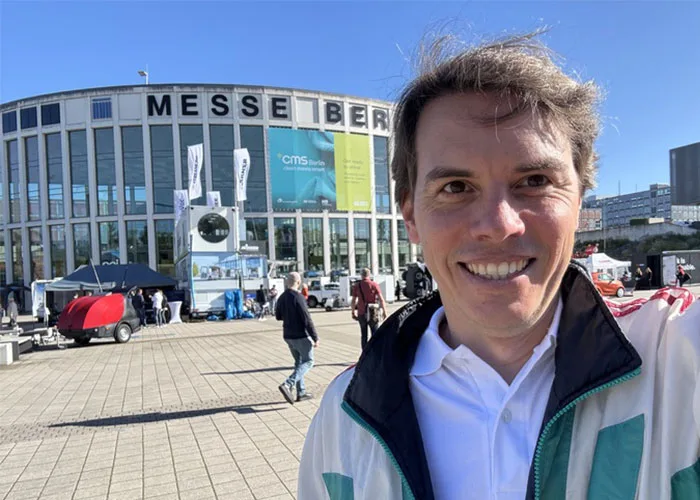
By Alexander Feil
CMS Berlin 2025 (23–26 September) didn’t argue for cleaning robots – it assumed them. Compared with two years ago, the mood shifted from “if robots will matter” to “how they scale, integrate, and hold up in messy reality.” Questions at booths were about fleet calibration, uptime, exception handling, and service design. The spectacle moved from generic floor scrubbers to tough edge cases.
The most filmed demo wasn’t another floor unit—it was a bathroom/toilet cleaning robot. Primech (Primech/Primech AI) showed HYTRON repeatedly handling toilets, sinks, and mirrors with autonomous brush changes and precise navigation in wet rooms. It’s exactly the kind of “last-mile” task that used to be dismissed as too irregular for automation—and exactly why visitors queued up. CMS itself flagged HYTRON in its daily update, highlighting live demos and its 3D sensing approach.
Another crowd-magnet lived off the floor. KTV Working Drone ran regular façade-cleaning demos on Hall 4: a tethered drone spraying windows and masonry from height, operated from the ground, the kind of risky, repetitive job that begs for a safer robotic workflow. CMS’s own day-two note put this front and center; KTV also announced its presence ahead of the show. Taken together, it signals that vertical surfaces are moving from concept video to operational showcase.
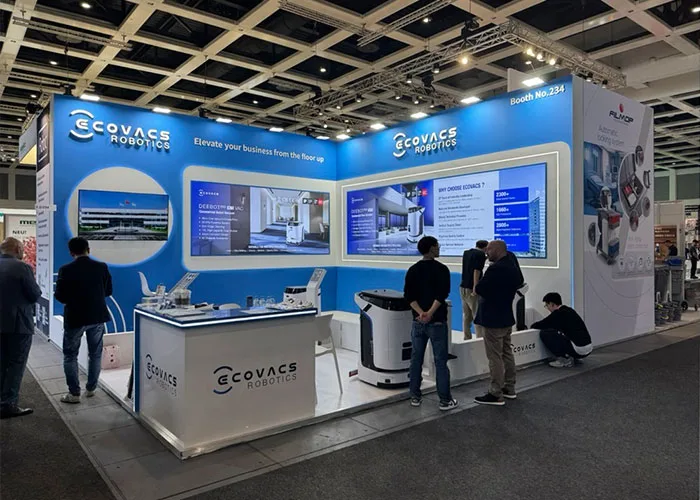
Ecovacs Commercial made a formal debut at CMS Berlin, pitching professional variants driven by the company’s navigation/software heritage and self-service station know-how from the consumer side. The messaging was about robustness and real-world readiness rather than novelty—consistent with the fair’s overall tone.
Late in the hall-talk came a surprise: Adlatus and Neura announced a strategic partnership and presented together for the first time at CMS. No M&A papers here, but the cooperation signals a European tilt toward tighter hardware-plus-cognitive stacks. If this deepens, it would mark a notable consolidation step in EU cleaning robotics.
On the technology axis, heated-water cleaning popped up in messaging and demos—raising water to ~80 °C to boost stain removal. Whether marketed as “thermal cleaning” or similar, the pitch is simple: improve efficacy, not just coverage. Expect pilots to probe when heat beats chemistry (or reduces it).
###
1) From pilots to process engineering.
Two years ago, debates circled viability; this year, the bottleneck is orchestration: repeatable deployments across many sites, with documented handoffs between humans and machines, and clear fallbacks when autonomy stumbles. The key discussions: calibration standards, exception taxonomies, and service SLAs that include robots. (You could hear it in the questions.)
Floors are “table stakes.” The energy has moved to wet rooms, verticals, and complex geometries—bathrooms with fixtures and tight stalls; façades, solar arrays, roofs. That’s where visitors pulled out phones and formed queues. Bathroom autonomy and drone façades are the new proof points.
Instead of big bang unveilings, vendors leaned into software reliability, self-diagnosis, workflow integration, and fleet tools. The market behaves less like gadget land and more like B2B infrastructure: fewer hero moments, more talk about APIs, data, and maintenance logistics.
The Adlatus–Neura tie-up reads like a waypoint toward deeper vertical integration in Europe. It’s not an acquisition—at least not now—but the direction is clear: pair a cleaning-domain incumbent with a cognitive robotics specialist. If it hardens, it will influence who sets de facto standards for perception, safety, and fleet behaviors.
Features like heated-water cleaning reframed the conversation from “does it navigate?” to “does it clean better?” That’s healthy: outcomes, not just autonomy, should decide category winners.
Hall talk hinted at new models being paced for the next Interclean cycle, but don’t expect shock therapy. Do expect: stronger bathroom modules (swappable tools, better perception in reflective/wet environments), maturing vertical-surface workflows (drones/gantries), and steadier API/telemetry unification between fleet managers and FM systems.
CMS Berlin 2025 was a barometer, not a fireworks show. The industry has moved past proving that robots can clean. The work now is scaling reliably, solving edge cases, and measuring efficacy. Bathrooms and façades stole attention because they represent the last hard yards. Partnerships like Adlatus × Neura hint at a European shift to integrated stacks; Ecovacs shows consumer DNA migrating into pro reliability. And small but telling tech like thermal cleaning reminds everyone that performance still matters more than autonomy theater. The hype window is closed; the operating window is open.